Tree Safety & Risk Prevention
Tree Removal in North Idaho: When It's Time to Call a Pro
Mick · September 17, 2025
In short: A tree needs to come out when it has a structural defect and something worth protecting sits in its fall zone. Cracks in the trunk, a fresh lean, fungal conks, a dead top, or roots heaving out of the soil are the signs we act on. Around here, most removals happen in tight quarters, which changes how the work gets done.
We take down trees for a living, and we still tell people to keep the ones they can. A healthy ponderosa shading the south side of a house is worth real money in summer. But North Idaho grows conifers 100 feet and taller, and it grows them close to cabins, shops, wellheads, and power lines. When one of those trees starts failing, the question stops being about looks and starts being about what it lands on.
When a tree actually needs to come out
The Forest Service definition of a hazard tree is useful because it has two parts: a defect that makes failure likely, and a target in the fall zone. A rotten snag in the back forty with nothing around it can stand there for decades feeding woodpeckers. The same snag leaning over a driveway is a different conversation.
So the first thing we ask on an estimate is not “is this tree ugly” but “what does it hit.” House, garage, propane tank, parked equipment, the neighbor’s fence, the road your kids walk to the bus stop. If the answer is “nothing,” you have options. If the answer is “the bedroom,” the timeline shortens.
The trees we most often end up removing in our service area are Douglas-fir with root disease, beetle-killed ponderosa and lodgepole, storm-cracked grand fir, and big cottonwoods near water that have started shedding limbs. Root disease deserves a special mention. Armillaria and other root rots are common in inland Northwest fir stands, and a fir with rotted roots can look green right up until a wet windstorm lays it over, root plate and all. The 2015 windstorm that hammered the Spokane area proved that point on thousands of trees that looked fine the day before.
Hazard signs worth taking seriously
You do not need to be an arborist to spot most of the warning signs. Here is what we look for on every assessment:
- Cracks and seams in the trunk. A vertical crack that opens and closes in wind means the stem is already failing.
- A new or increasing lean. Trees that grew leaning are usually fine. A tree that leaned five degrees last year and fifteen this year is moving, and soil mounding or fresh cracks on the uphill side of the roots confirm it.
- Fungal conks and mushrooms. Shelf fungus on the trunk or honey-colored mushrooms clustered at the base point to decay inside wood that still looks solid outside.
- Dead tops and thinning crowns. A fading crown on a conifer often means root or beetle trouble below. Pitch tubes, the little popcorn-looking blobs of resin on pine bark, mean beetles have already moved in.
- Codominant stems with included bark. Two trunks of similar size joined in a tight V, with bark folded into the union, is one of the most common failure points we see, especially in grand fir and birch.
- Root damage. Trenching for a new septic line, a driveway cut, or grading within the dripline can kill roots on one side and set up a failure years later.
One sign that fools people every fall: western larch, what most locals call tamarack, drops all its needles every year. We get calls each November about a “dead” tree that is just a larch doing what larch does. If it needled out gold before the needles fell, it is alive. Save the removal money.
Why close-quarters removal is different here
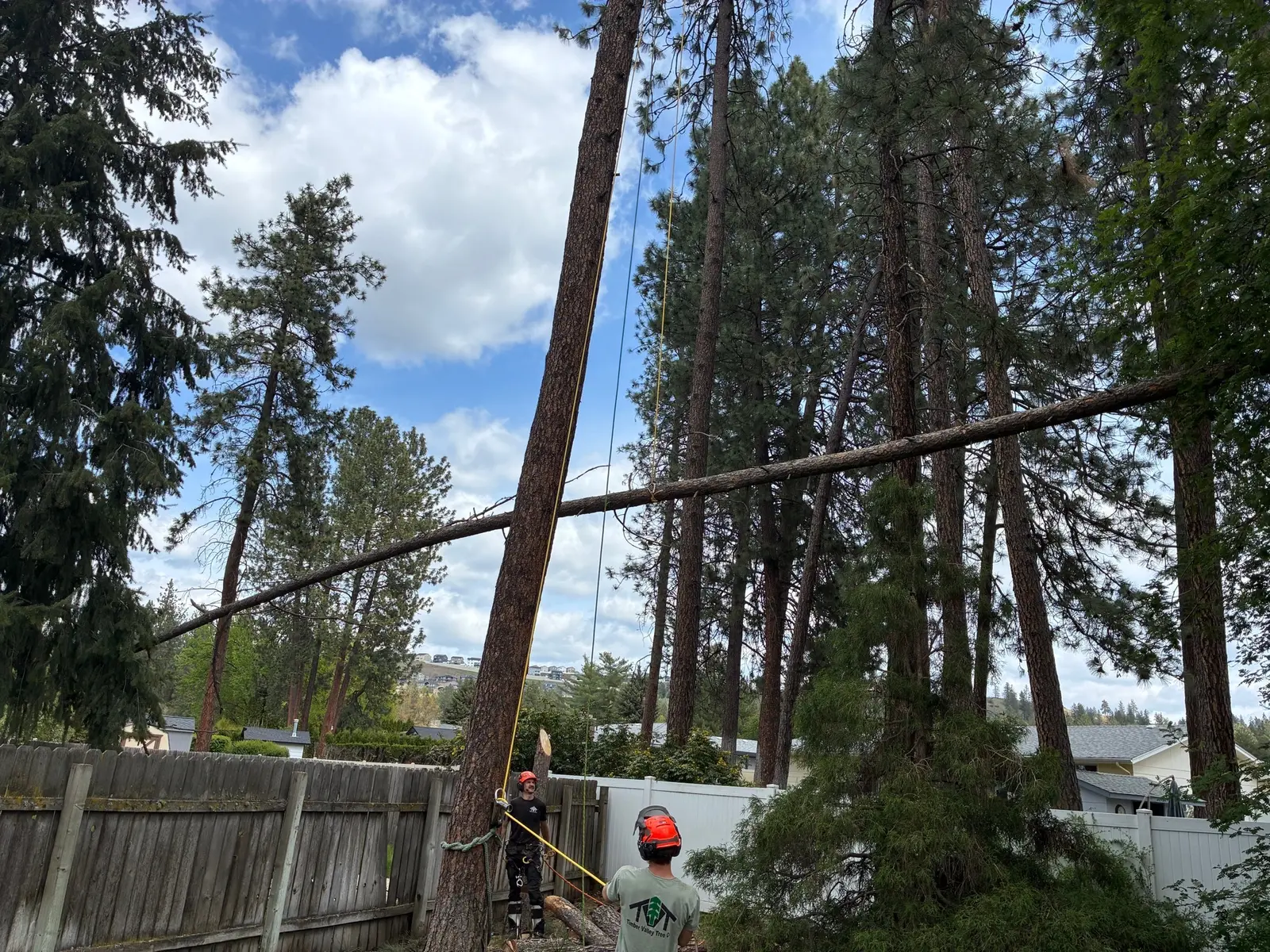
Drive the lakeshore at Priest Lake or the cabin roads around Spirit Lake and you will see the problem: 120-foot trees standing 15 feet from a roofline, with a narrow gravel drive, a drainfield you cannot park on, and no room to lay anything down. Straight felling, the way you would drop a tree in open timber, is off the table. There is no direction it can fall without hitting something.
Close-quarters removal means taking the tree apart from the top down. A climber or a lift operator works down the stem, and every piece that could damage something gets roped, rigged, and lowered under control. On a big ponderosa over a house, that can mean dozens of individual picks, each one caught on a rope and eased down instead of dropped. It is slower and more technical than open felling, and it is why removing a tree over a cabin is a different job than removing the same species out in the pasture.
Terrain adds its own complications. A lot of our work sits on slopes above lakes, where the low side of the tree hangs over water or a bank you cannot stage equipment on. Soft spring ground on the Rathdrum Prairie and the valley bottoms limits where trucks can go without rutting a yard. Part of our estimate visit is figuring out access: where the chip truck parks, what the loader can reach, and what has to come out by hand.
If you want a rough sense of what a removal runs before we come out, our tree removal calculator walks through the factors that move the number: height, access, what is under the tree, and condition of the wood.
What a removal looks like with us
Every job starts with a free on-site estimate. We look at the tree, the targets, and the access, and we tell you honestly whether it needs to come out or whether trimming or monitoring makes more sense. When removal is the call, the crew handles rigging, felling or piecing down, bucking the wood, and cleanup. You can keep the logs for firewood, we can haul them, and stump grinding is available as a follow-up so you are not mowing around a monument for the next twenty years.
Our tree removal service covers the whole area from Blanchard out about 25 miles in every direction, from Spirit Lake and Priest River across the state line to Newport and Deer Park.
Common questions about tree removal in North Idaho
How do I know if my tree is dead or just dormant?
Scrape a small patch of bark on a twig: green underneath means alive. On conifers, brown needles across the whole crown in summer means dead, but remember that western larch drops all its needles every fall on purpose. A tree that fails to green up by late spring is the real red flag.
Do I need a permit to remove a tree on my property?
On private residential land in unincorporated Bonner and Kootenai counties, generally no. Cities can have their own rules, shoreline and waterfront properties can involve county or state review, and trees near power lines involve the utility. We flag anything that needs a call before we cut.
Can I take down a tree myself?
A small tree in the open with nothing in its fall zone, maybe. A tree taller than the distance to your house, anything leaning, anything dead and brittle, or anything near lines is where homeowners get hurt. Chainsaw injuries and crushed structures cost far more than a professional removal.
What time of year is best for tree removal?
Hazard trees come out whenever they are found; a failing tree does not wait for good weather. For non-urgent removals, late summer through winter works well here. Frozen or dry ground protects lawns, and removing pine outside the spring flight season avoids attracting bark beetles to fresh wood.
What happens to the wood after removal?
Your call. Most customers keep bucked rounds for firewood, and we haul the brush and chips. We can also haul the logs entirely, and on larger jobs with merchantable timber, log-length wood can go to a mill instead of the burn pile.
If there is a tree on your place you have been watching with one eye, have us look at it before the next windstorm makes the decision for you. Get in touch or call (208) 920-9979 and we will walk it with you. The estimate is free.