
The fire problem here is specific, and it is growing
North Idaho and Eastern Washington burn on a rhythm: green spring, dry July, and an August-September stretch where one lightning strike or dragged chain can run a fire through cured grass and brush fast. What has changed is the fuel. Pine bark beetles have killed stands across the region, and every dead pine is standing kindling with a dry crown. The December 2025 windstorm added blowdown that is now drying on the forest floor. Meanwhile more people build cabins and homes back in the timber every year. None of that is a reason to panic. It is a reason to treat the hundred feet around your house as seriously as the house itself.
Defensible space, zone by zone
Defensible space is not a moat of dirt. It is a set of zones where fuel gets progressively lighter as fire would approach the house, following the same framework Firewise programs and fire agencies teach. Worked together, the zones do two jobs: they starve a ground fire before it reaches the walls, and they give firefighters a property they can actually defend instead of one they drive past.
- Zone 0, the first 5 feet: nothing that burns against the structure. No bark mulch against siding, no firewood stack on the porch, no juniper foundation shrubs, no needle-loaded gutters.
- Zone 1, 5 to 30 feet: lean and green. Trees limbed up, crowns separated, brush out, grass short, deadwood gone.
- Zone 2, 30 to 100 feet: thinned timber. Wider tree spacing, ladder fuels removed, ground fuels broken up so fire stays low and slow.
Ladder fuels and crown spacing, the two levers that matter
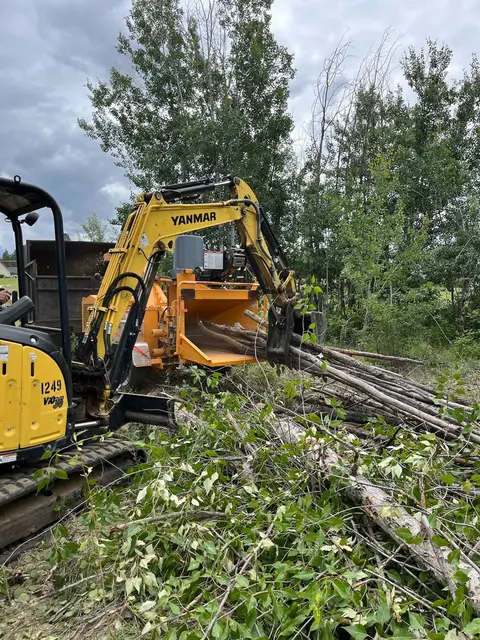
A ground fire in grass and needles is survivable for a stand and often for a house. A crown fire is not. What turns one into the other is the ladder: brush under a low-limbed tree, a young fir growing beneath a mature pine, limbs drooping into tall grass. Fire climbs that ladder from the ground into the canopy, and once it is in the crowns it moves with the wind. So we limb mature trees up, remove the understory ladder beneath them, and open space between crowns so fire cannot step tree to tree. On most properties this removes surprisingly few whole trees. It is mostly hand saws, brush work, and the forestry mulcher, and the woods look better afterward, not worse.
Insurance companies are now grading your lot
Carriers have started refusing to renew policies on WUI properties they judge undefendable, and others send inspection letters requiring mitigation within a deadline. We hear it from customers across the region: the letter arrives, it names brush, limbs, and trees near the structure, and it gives a date. We do the work the letter describes and we document it: dated before-and-after photos, an invoice itemizing what was cut and where, keyed to the zones. That paper trail is what you send back to the carrier. We cannot promise what any insurer will decide, but a documented, honestly mitigated property is the strongest answer you can give them.
Cost-share help exists. Check it before you pay full freight.
Fuels reduction on acreage is real money, and you may not have to carry all of it. The Idaho Department of Lands runs cost-share programs that help private landowners pay for fuels reduction and defensible space work, and the Washington Department of Natural Resources does the same on their side of the line. Programs change year to year, budgets open and close, and the details depend on your county and acreage, so call them or ask us and we will point you at the current door to knock on. We are glad to work under a cost-share project and provide whatever documentation the program requires. The homework can cut the out-of-pocket cost of the same work substantially.
When to do the work
The best window for fuels work is fall through spring. The ground is moist or frozen, fire restrictions are off, chipping and mulching can run all day, and the work is done before the property dries out in July. Late spring works if the project starts early. What we try to steer people away from is calling in August with smoke already in the valley, when every crew in the region is booked and half the work is restricted anyway. Mitigation also is not a one-time purchase: brush regrows, needles fall, and a touch-up every few years keeps the zones honest. We offer return visits on a schedule so it stays maintained without you thinking about it.
What does wildfire mitigation cost in North Idaho?
Every property is quoted on its own numbers. The drivers are acreage treated, how thick the brush and understory are, how many trees need limbing versus full removal, whether material gets mulched on site or hauled, and slope and access for equipment. A maintained lot needing a touch-up sits at one end, and ten untouched acres of doghair fir sit at the other. Cost-share through the Idaho Department of Lands or WA DNR can offset a real share on qualifying acreage, and we will tell you if your project looks like a fit. The walk-through and written quote are free.
Why homeowners call us
- Zone-based plans, not one-size-fits-all clearing
- Ladder fuels and crown spacing handled by an actual tree crew
- Forestry mulcher turns brush into ground cover on site
- Dated photo documentation written for insurance carriers
- We flag cost-share programs before you overspend
- Return maintenance visits keep the zones honest
How the job goes
- STEP 1
Walk the whole property
We assess fuels from the siding out to 100 feet and beyond: brush, ladder fuels, crown spacing, dead trees, and the slope and wind exposure that shape fire behavior on your lot.
- STEP 2
Get a zone-by-zone plan
You get a written scope keyed to Zones 0, 1, and 2, with a firm price, and a heads-up if your acreage looks like a candidate for state cost-share help.
- STEP 3
Cut, thin, mulch, haul
The crew limbs, thins, and clears per the plan. Brush is chipped or mulched on site, merchantable wood is decked or hauled, and dead trees come down.
- STEP 4
Document and maintain
You receive before-and-after photos and an itemized invoice for your insurer, plus an optional return schedule to keep the work current.
When we'd talk you out of it
- Clearcutting the whole lot. A scalped lot grows back as brush and doghair thicket, which burns hotter than the thinned stand you removed. Spacing, limbing, and ladder fuel removal protect the house and keep the forest.
- Paying full price before checking cost-share. If budget is the obstacle, ask the Idaho Department of Lands or WA DNR about cost-share first. We would rather do the job next season with their help than half the job now.
- Spending everything on your back forty when the real hazard is the neighbor's untouched fuel bed 40 feet from your wall. Your first dollars belong in Zones 0 and 1. We will walk the line with you, and with the neighbor if they are willing.
Wildfire Prevention questions
What is defensible space?
Defensible space is the buffer between your house and the fuels around it, managed in zones: nothing flammable in the first 5 feet, lean and clean from 5 to 30 feet, and thinned timber from 30 to 100 feet. It slows fire near the structure and gives firefighters a property they can defend.
Will my insurance company accept your mitigation work?
Carriers set their own standards, so no contractor can promise acceptance. What we provide is what they ask for: work matched to the zones their letters cite, dated before-and-after photos, and an itemized invoice. Customers use that package to answer inspection letters and nonrenewal notices. Bring us the letter and we will scope to it.
Do I have to remove all the trees around my house?
No, and you should not. Effective mitigation is mostly limbing trees up, clearing the brush ladder beneath them, and opening crown spacing, with removals reserved for dead, beetle-hit, or badly placed trees. A healthy, well-spaced stand shades out the brush regrowth that a bare lot invites. The goal is a forest that fire walks through low, not a moonscape.
When is the best time of year for this work?
Fall through spring. Moist or frozen ground, no fire restrictions, and the work is finished before the July dry-down. Summer work is possible but restricted and busy. The worst plan is calling during fire season with smoke on the horizon, when every crew is booked. If you are reading this in winter, this is the window.
How often does defensible space need to be redone?
The heavy lift happens once. After that, brush resprouts, needles and limbs accumulate, and small conifers seed back in, so a lighter touch-up every two to three years keeps the zones effective. Annual attention to Zone 0, gutters, and needle load is worth doing yourself. We offer scheduled return visits so it never slides back to where you started.