
The first five feet decide more than anything else
Most homes lost to wildfire are not overrun by a wall of flame. They catch from embers landing in the small fuels touching the structure: bark mulch against the siding, needles packed in gutters and roof valleys, a woodpile on the porch, juniper and other resinous shrubs planted at the foundation. Zone 0 work is unglamorous and decisive. We pull flammable vegetation out of the first five feet, clear needle load off roofs and out of gutters and corners, get stacked wood away from walls, and limb anything hanging over the roofline. It is a short list, it is cheap compared to everything else, and it does more for the house than any other single dollar you spend.
Five to thirty feet: lean, green, and spaced
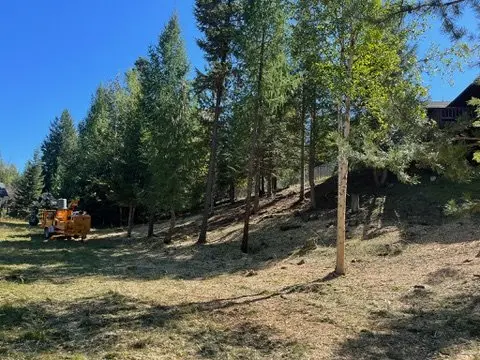
Zone 1 is where a ground fire either lies down or reaches the house, so the standard is lean and green. We remove brush and deadwood, limb mature trees up so flames cannot climb into them, take out the small suppressed conifers growing beneath big ones, and open spacing between crowns near the structure. Healthy, well-trimmed trees can stay, and should: shade keeps the brush from coming right back. On the ground we break up continuous beds of needles and duff so fire has no unbroken path. When we finish, the area reads as a clean, parklike yard, not a cleared pad. Most owners tell us it is the best the property has ever looked.
Cabins and lake places, cleared while you are away
A big share of our defensible space work is on seasonal places around Priest Lake, Spirit Lake, and Pend Oreille, where the owner is elsewhere ten months of the year and fuels build up unwatched. An unoccupied cabin in the timber is exactly the property that needs the buffer most, because nobody is there to notice smoke or move a woodpile. We handle these jobs on our own schedule and yours: walk the lot with you once, or work from photos and a phone call, then send dated before-and-after pictures when the work is done. Plenty of lake owners put us on a return cycle so the place is fire-ready every July without a trip north.
What does defensible space clearing cost in North Idaho?
Price follows fuel load and footprint. The drivers are how many structures we are buffering, how thick the brush and understory are in each zone, how many trees need limbing or removal, slope and equipment access, and whether debris is chipped on site or hauled out. A maintained yard needing a Zone 0 and limbing pass is a small job. A cabin with twenty years of untouched understory is not. We quote it zone by zone at a free walk-through, so you can do the work all at once or in phases starting at the house.
Why homeowners call us
- Ember zone cleared: mulch, needles, and fuels off the structure
- Trees limbed up so fire stays out of the crowns
- Brush and ladder fuels cut, chipped, and hauled
- Parklike finish, not a scraped lot
- Photo documentation for insurance letters
- Absentee-owner friendly, before-and-after photos sent
How the job goes
- STEP 1
Assess the home ignition zones
We walk the hundred feet around each structure and note fuels by zone: what touches the house, what carries fire to it, and what lets fire climb.
- STEP 2
Scope it zone by zone
The written quote lists the work per zone so you can see what each ring costs and phase the job if you want to.
- STEP 3
Clear and limb
The crew works from the walls outward: Zone 0 cleanup first, then brush, ladder fuels, limbing, and spacing out to 100 feet.
- STEP 4
Haul, photograph, schedule
Debris is chipped or hauled, you get dated photos of the finished zones, and we set a return interval if you want it maintained.
Defensible Space questions
How far from my house should defensible space extend?
The working standard is 100 feet, treated in rings: nothing flammable in the first 5 feet, lean and green from 5 to 30, and thinned timber from 30 to 100. On steep slopes the distances stretch further downhill, because fire runs uphill fast. If your lot line comes first, we treat to the line and talk to you about the rest.
Will defensible space clearing make my property look bare?
Done right, no. The work is mostly limbing, brush removal, and selective spacing, and the result reads as an open, parklike stand with healthy trees kept. Whole-tree removals are reserved for dead, beetle-hit, or badly placed trees near structures. Most owners think the property looks better after than before, and the photos back that up.
Can you do the work while I am away for the season?
Yes, and for lake cabins that is our normal mode. We scope the job with you on site or from photos, do the work while the place is empty, and send dated before-and-after pictures with the invoice. Many seasonal owners around Priest Lake and Spirit Lake keep us on a return cycle so the cabin is ready every fire season.
Is this the same thing as wildfire prevention?
It is the core piece of it. Defensible space clearing is the physical work in the hundred feet around structures. Full wildfire prevention also covers stand thinning on the rest of the acreage, insurance documentation, timing, and cost-share programs, which we cover on our wildfire prevention page. Many properties need this service first and the rest in phases.