Tree Care & Maintenance
Tree Trimming in North Idaho: What to Cut and When
Mick · August 6, 2026
In short: Most trees in North Idaho are best trimmed in late summer through winter, when growth has slowed and pests are quiet. Pine is the exception with teeth: fresh pine slash cut between January and July breeds pine engraver beetles, so we schedule ponderosa and lodgepole work for late summer and fall. Good trimming removes deadwood and end weight so limbs survive wet snow, and it never involves topping.
Trimming is the tree work people put off longest, because nothing looks broken yet. Then a wet October snow lands on a full-leafed birch or a long ponderosa limb over the garage, and the job changes from a trim to a repair. Most of what we cut on emergency calls could have been a planned cut a season earlier, at a fraction of the mess.
Timing by species: our trees, our calendar
National tree-care advice says to make your cuts in late winter. That is fine for an orchard in Ohio. Here, the calendar is set by two local realities: bark beetles and snow.
Ponderosa and lodgepole pine: late summer through early winter. The pine engraver beetle (Ips pini) breeds in fresh pine slash, and the Idaho Department of Lands is blunt about the season: avoid creating pine slash between January and July, because the moist inner bark in those months supports a fast beetle buildup. Beetles that breed in your slash piles emerge and attack the live pines you were trying to help. So we cut pine from August into winter, and we chip or haul the slash rather than leaving green piles near standing trees.
Douglas-fir and grand fir: fall and winter. Dormant-season cuts close well, and working after fire season means the brush can be dealt with safely. On big Douglas-fir, we keep an eye out for beetle activity in the area before creating large fresh wood.
Western larch: winter, when it is bare. Larch drops its needles every fall, which makes winter the easiest time to see structure and deadwood. It also confuses people; a bare larch in December is dormant, not dead.
Birch, maple, and aspen: mid-summer or fall, not early spring. Birch and maple are heavy sap bleeders if cut just before leaf-out. The bleeding is more alarming than harmful, but cuts made in July or after leaf drop stay tidier. Birch in our area also deals with bronze birch borer pressure, so we avoid cutting on stressed birch in the borer flight months of early summer.
Fruit trees: late winter. The orchard advice does apply to the apples and plums scattered around old homesteads from Priest River to Deer Park. Late February and March, before bud break, is the window.
Snow-load weight reduction: the cut that saves roofs
The limb failures we see most are not from wind. They are from wet snow, the heavy Cascade-concrete kind that comes when temperatures hover right at freezing, and from rain-on-snow events that turn a loaded crown into a soaked sponge. A long horizontal limb that carries its weight fine all summer picks up hundreds of pounds of snow in one storm.
Weight reduction is the answer, and it is a specific set of cuts:
- End-weight reduction. Shortening long, over-extended limbs back to a strong lateral branch, so the lever arm gets shorter and the snow load moves closer to the trunk.
- Deadwood removal. Dead limbs are the first to release under load, and they fall without warning at any time of year.
- Selective crown thinning. Removing a modest share of live growth so snow and wind move through the crown instead of piling onto it. Modest is the key word; stripping a conifer thin stresses it.
- Clearance cuts. Getting limbs off the roofline, the chimney, and the power service drop before winter, with enough margin that a snow-bent limb still clears.
What weight reduction is not: topping. Cutting the top out of a conifer or hacking limbs back to stubs creates dense regrowth that is weakly attached and heavier than what you removed within a few years. It also opens big wounds that decay. We do not top trees, and we will talk you out of it if you ask. If a tree is so tall over a target that topping seems like the only option, that is usually a removal conversation, and an honest one.
Trimming as fire work
There is a second reason to trim conifers here, and it has nothing to do with snow. Low limbs are ladder fuels: they carry a ground fire up into the crown. Limbing conifers up 10 feet or so (without taking more than the lower third of the live crown on younger trees) is one of the core defensible-space treatments on any wooded lot from Blanchard to Newport. If your trimming list is mostly about the trees within 100 feet of the house, it is worth reading about our wildfire prevention work, because the same visit can handle both.
What good cuts look like
Every proper cut lands just outside the branch collar, the swollen ring where limb meets trunk, so the tree can seal the wound. Flush cuts into the trunk and stub cuts that leave a coat hook both invite decay. We also avoid lion-tailing, the practice of stripping all interior growth and leaving tufts at the limb ends, which concentrates weight exactly where you do not want it in snow country.
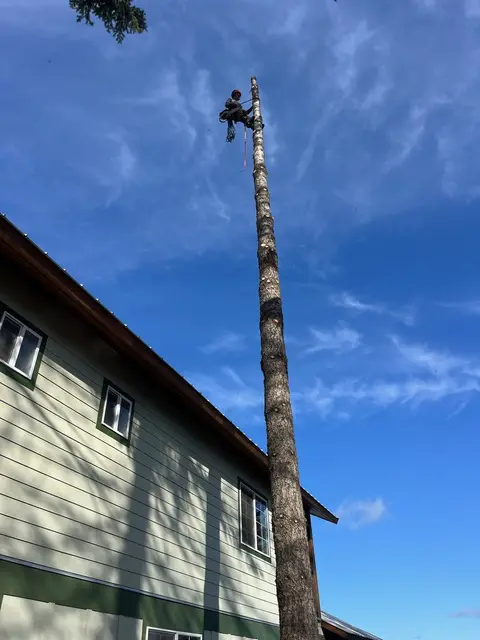
On tall conifers this is climbing work. A climber on rope, or a lift where access allows, works through the crown making individual cuts, and everything roped down gets lowered away from roofs, wires, and gardens. Brush gets chipped the same day. Around Sandpoint and the lake communities, most of our trimming jobs are exactly this: big conifers, tight access, and a homeowner who wants the tree kept, not removed.
Common questions about tree trimming in North Idaho
When is the best time to trim pine trees in North Idaho?
Late summer through early winter. Fresh pine slash created between January and July breeds pine engraver beetles, which emerge and attack nearby live pines. Cutting pine in August through December, then chipping or hauling the slash, keeps your trim job from becoming a beetle problem next June.
How much can you cut off a tree at once?
A general ceiling is about a quarter of the live crown, and less for mature or stressed trees. More than that pushes the tree into stress growth and starves its energy reserves. Heavy correction is better done over two or three seasons than in one aggressive afternoon.
Should I top my tree to make it safer?
No. Topping creates weakly attached regrowth that gets heavier and more failure-prone than the original top within a few years, and the big open wound invites decay. Proper weight reduction shortens limbs back to strong laterals. If height over a target is the real worry, removal is the honest option.
Will trimming hurt my tree during a drought summer?
Heavy trimming during hot, dry stretches adds stress, and open wounds on pine can attract beetles in flight season. Light deadwood removal is fine any time. We schedule bigger structural work for fall and winter, which suits both the trees and the beetle calendar.
Do you haul away the branches?
Yes. Chipping and cleanup are part of the job, and it matters here for more than tidiness: green conifer slash left in piles near live pines is beetle habitat, and dry slash is fire fuel. Chips can stay for your paths and beds, or leave on the truck.
If a limb has been hanging over the roof all summer, this is the season to fix it. Book a free estimate or call (208) 920-9979 and we will walk the property, mark what needs to come off, and get it done before the first wet snow does the trimming for you.