
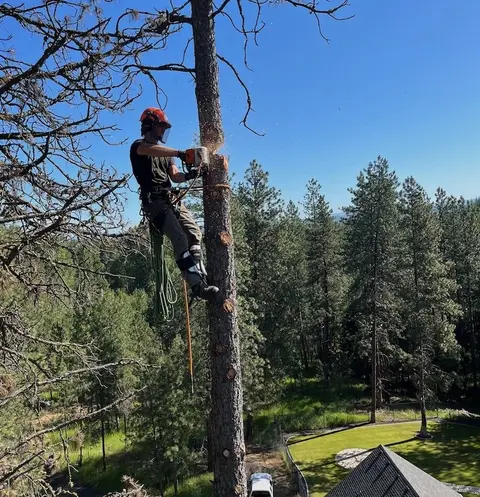
Between the biggest lake in Idaho and the biggest ski hill
Sandpoint sits pinched between Lake Pend Oreille, Idaho's largest and deepest lake at forty-three miles long, and the Selkirk front rising to Schweitzer, the state's largest ski resort. That geography writes the weather. Wind gets a forty-mile fetch across open water before it hits lakefront trees, and the snow that makes Schweitzer famous falls wet and heavy on every crown in town on its way up the mountain. The trees here are worth the trouble: mature ponderosa, fir, and cedar over established in-town yards, big lakefront conifers framing water views, and forest-edge stands on the benches above town. Our work in Sandpoint is mostly keeping those trees healthy and safe, and taking them down carefully when they are past that point.
Lake wind, snow load, and the failures they cause
The removals we do around Sandpoint cluster into two patterns. Wind-thrown and wind-cracked trees show up on exposed lots near the water and along the Long Bridge approaches, where gusts hit hardest and the soil is often shallow over rock. Snow-load failures show up everywhere else: broken tops, split leaders, and hung limbs after the heavy dumps, especially in crowded stands where trees grew tall and thin. Preventive trimming addresses both, and it is most of what we would rather be doing here. Thinning a sail-heavy crown before November costs a fraction of craning a failed tree off a roof in January, and we will always tell you which side of that line your trees are on.
Fire country note
The benches and draws above Sandpoint, up toward Schweitzer and along the forest edge, are classic wildland-urban interface: homes tucked into continuous timber with beautiful views and real summer fire exposure. Insurers have started paying attention to that across North Idaho. Our defensible space and thinning work opens the ground around homes, pulls fuels off structures, and leaves the property both safer and easier to insure.
How our wildfire prevention work goes →Areas we work around Sandpoint
What we do in Sandpoint
Tree Removal
Our core service. Dead, leaning, and beetle-killed trees taken down safely in tight quarters, with full cleanup every time.
Learn moreTree Trimming
Trimming built for snow country: weight reduction before winter, roof clearance, structure work, and view cuts that do not wreck the tree.
Learn moreEmergency Service
Storm damage response from a local crew, available 24/7. We make it safe, get the tree off the structure, and document the work for your insurance claim.
Learn moreWildfire Prevention
Our flagship service. Defensible space, ladder fuel removal, and stand thinning for homes in the wildland-urban interface, documented for your insurer.
Learn moreStump Grinding
Stumps ground well below grade and cleaned up, with a remote-operated grinder for backyards, slopes, and spots a tow-behind machine cannot reach.
Learn moreSandpoint questions
Is Sandpoint too far for you to take small jobs?
No, but we schedule them smartly. Single stumps, one-tree removals, and small trims in Sandpoint get grouped with other Bonner County work so the drive is shared across jobs rather than billed to one customer. Tell us what you have; the estimate is free and we will be straight about timing.
What determines tree removal cost in Sandpoint?
Size, condition, access, and targets: what the tree could hit on its way down. Lakefront removals over decks, boathouses, or tight lot lines take rigging and time. Crowded in-town lots are similar. A tree we can fell whole on open ground is always the cheapest version of the job.
My lakefront pines take the full wind off the water. Should I be worried?
Exposed lakefront trees deserve a look every few years. Warning signs worth a call: a new lean, heaving soil at the base, dead tops, or limbs dropping in moderate wind. Crown thinning helps wind pass through instead of loading the tree. We will assess honestly, and often the answer is a trim, no removal.
Do you handle storm cleanup in Sandpoint after big blows?
Yes. After significant wind or snow events we run routes through Bonner County and triage by hazard, with trees on structures and blocked access first. Being fifty minutes out means Sandpoint is well inside our storm response range. Call early; storm schedules fill in the order calls come in.