Tree Safety & Risk Prevention
Wildfire Prevention in North Idaho: Defensible Space That Actually Works
Mick · August 6, 2026
In short: Defensible space is built in zones: keep the first 5 feet around the house free of anything that burns, thin and limb the trees from 5 to 30 feet, and break up dense fuels out to 100 feet and beyond. The work that matters most on a wooded North Idaho lot is removing ladder fuels, the brush and low limbs that carry a ground fire up into the tree crowns. Insurers are now checking for it.
Most of our service area is, by any honest definition, forest with houses in it. Blanchard, Spirit Lake, Priest River, the Hoodoo Valley, the timbered ridges above Newport and Deer Park: these are wildland-urban interface communities, the WUI, where a fire that starts in the woods arrives at somebody’s driveway. Fire season here runs hard from July into September, and the smoke that settles into our valleys most Augusts is the annual reminder.
The good news is that defensible space is not a mystery and it is not clear-cutting. It is a specific set of treatments, done in the right order, and a wooded lot can stay wooded and still be defendable.
The zones, from the siding out
Fire scientists break home protection into distances, and the closer to the house, the more the details matter.
Zone 0: the first 5 feet. The ember zone. In a big fire, wind-driven embers land against the house by the thousands, and whatever they land on decides the outcome. Bark mulch against the foundation, needles in the gutters, firewood on the porch, junipers under the windows: these are ignition wicks. This zone should be rock, gravel, concrete, bare soil, nothing that holds a flame against your siding.
Zone 1: 5 to 30 feet. Trees here get thinned so crowns do not touch, limbed up, and cleaned of deadwood. Brush comes out or gets reduced to isolated, watered plantings. Firewood stacks, slash piles, and the boneyard of old lumber behind the shop all need to move outside this ring.
Zone 2: 30 to 100 feet and beyond. The goal shifts from ignition prevention to reducing fire intensity: thinning dense stands, spacing tree groups, removing standing dead trees, and mowing or mulching brush fields so a fire arriving at your property drops from the crowns to the ground, where it can be fought. On sloped ground the distances stretch, because fire runs uphill fast; a house on a timbered slope above Spirit Lake needs more depth below it than a flat lot in town.
Ladder fuels: the mechanism that matters
A ground fire in light fuels, grass and needles, is survivable for a stand of mature ponderosa; thick bark is the species’ whole strategy, and the open, park-like pine stands early settlers described were shaped by exactly that kind of frequent low fire. What kills trees and houses is fire climbing: from grass into brush, from brush into low limbs, from low limbs into the crown. Once fire is in the crowns, it moves at wind speed and throws embers a mile ahead.
Every rung you remove breaks the ladder:
- Brush under trees. Ceanothus, ocean spray, young fir thickets under bigger trees. This is the fuel that does the lifting.
- Low limbs. Conifers limbed up about 10 feet, or a third of live crown height on younger trees, cannot catch fire from the ground as easily.
- Sapling thickets. The doghair regeneration that fills every opening here, especially grand fir and Douglas-fir coming up under pine, is a ladder and a torch at once. Our mixed stands have spent decades without the low-intensity fires that used to clean them out, and the fir understory that grew up in that gap is exactly what carries fire today.
- Standing dead. Beetle-killed pine and fir snags burn like matchsticks and throw embers. They are also the trees most likely to drop on a fire crew, which is why engine crews will not defend a house surrounded by snags.
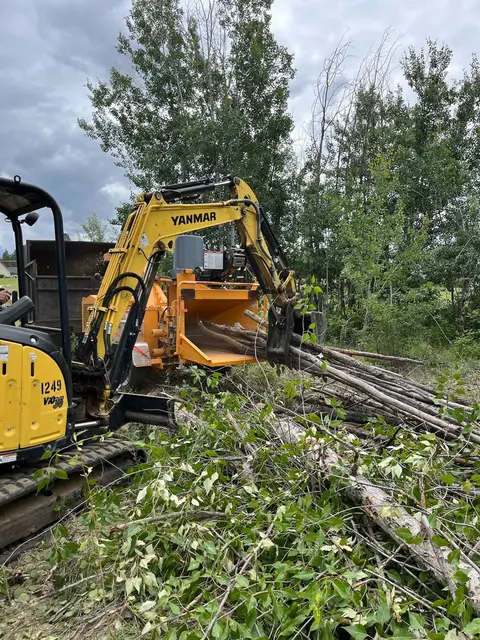
On acreage, the efficient tool for the brush and thicket layers is a forestry mulcher, which grinds standing brush and small stems into a chip layer in place. For larger wooded parcels, mechanical forest thinning does the same work at stand scale. Timing matters in beetle country: we schedule heavy pine work for late summer through winter so fresh slash does not sit through the spring beetle flight.
The insurance pressure is real
The other reason this work has moved up people’s lists: insurers are looking. Companies now score wildfire exposure with aerial imagery and third-party risk models, and WUI homeowners across the West, including our corner of it, have seen non-renewal letters, new mitigation conditions, and inspection requests. Photos of cleared zones, dated invoices for fuel reduction, and a documented maintenance schedule are becoming the currency that keeps policies in force. When we do defensible space work, our invoice describes the treatments specifically so it can go straight into your insurance file.
This region does not have to imagine the underlying risk. In August 2023, the Oregon Road Fire near Elk, a few minutes from our Deer Park service area, and the Gray Fire at Medical Lake together burned hundreds of homes in a single afternoon of wind. Both started small and moved through exactly the fuels this work removes.
There is help paying for it, too. Idaho and Washington both run cost-share and assistance programs for landowners doing fuel reduction; we wrote a full guide to defensible space cost-share programs covering who to call on each side of the line.
What we actually do on a defensible space job
Every job starts with a walk-around: where fire would come from, what it would climb, what the wind does on your slope. Then the work, in priority order: snag removal, ladder-fuel brush and limbing in zones 1 and 2, thinning to break up crown continuity, and mulching or hauling the slash so we do not leave next year’s fuel on the ground. Full details are on our wildfire prevention page, and the zone-by-zone treatment around structures is covered under defensible space clearing.
What we will not do is strip a lot bare. Spacing, not scalping: a properly thinned ponderosa stand is more fire-resistant, healthier, and better looking than either a thicket or a moonscape. We have talked more than one customer out of cutting trees that were doing no harm and into removing the brush layer that was the actual problem.
Common questions about defensible space in North Idaho
How much clearance do I need around my house for wildfire?
Work in zones: nothing combustible in the first 5 feet, thinned and limbed trees from 5 to 30 feet, and reduced fuels out to 100 feet, further on slopes. You do not need bare dirt. You need embers to find nothing at the house and fire to stay out of the crowns.
Do I have to cut down all my trees to be fire safe?
No. Well-spaced, limbed-up mature trees, especially thick-barked ponderosa, survive ground fire and even shield a house from radiant heat. The priorities are standing dead trees, dense sapling thickets, brush under trees, and low limbs. Most lots keep the majority of their mature trees.
Will defensible space work lower my insurance premium?
Sometimes, and increasingly it decides whether you keep coverage at all. Insurers in WUI areas are using aerial imagery and inspections; documented mitigation with dated photos and itemized invoices strengthens your file. Ask your agent what their carrier requires, then keep records of the work.
When is the best time to do fuel reduction work?
Fall through spring. The ground is soft for equipment cleanup, burn permits for slash are easier outside closed fire season, and cutting pine outside the beetle flight window avoids breeding pine engravers in fresh slash. Summer work is possible, but equipment restrictions apply during high fire danger.
What is a ladder fuel, exactly?
Anything that lets fire climb from the ground into tree crowns: tall grass into brush, brush into low limbs, saplings under mature trees. Remove the middle rungs and a fire stays on the ground, burning needles and grass instead of whole trees. Ladder fuel removal is the highest-value treatment on most wooded lots.
August smoke is a good motivator, but fall is the working season. If you want a straight assessment of what your place needs, schedule a free walk-through or call (208) 920-9979 and we will map the zones with you before the next fire season shows up.